Showing posts with label artist books. Show all posts

Tuesday, May 08, 2007

Exhibit: Bookworks 8 (LitChick Blog)


The Cincinnati Book Arts Society (CBAS) is holding its 8th annual exhibit of traditional and contemporary handmade books in the Atrium of the Main Branch of the Cincinnati Public Library from May 2 to June 25. Check out this blog for more photos: LitChick: Art of the book celebrated in new exhibit.

Pictured Artist: Margaret Rhein

Sunday, May 06, 2007

Exhibit: Bookworks 8 Opening

Family and friends turned out today, for the official opening reception for Bookworks 8, Cincinnati Book Arts Society's (CBAS) annual book arts exhibit. It's a highly recommended visit and, if there is a copy of the artists' statments around, I encourage you pick it up and read it. It will enhance your enjoyment of the exhibit.


Dr. Sylvan Golder and his wife, Faith, study daughter-in-law Margaret Rhein's See Me, See You, one sheet books created from prints of primates made during a monoprinting workshop.


Cecie Chewning's Too Much Information, is her creative and humorous response to the piles of unsolicited catalogues she receives in the mail on a regular basis.


Karen Hanmer's Bluestem was inspired by Willia Cather's My Antonia: Everywhere, as far as the eye could reach, there was nothing but rough, shaggy, red grass ... And there was so much motion in it; the whole country seemed, somehow, to be moving.


Beth Belknap Brann, London Underfoot: A Pure Photographic Alphabet. In the summer of 2001, Beth spent a month in London, much of her free time walking through neighborhoods photographing random letter forms formed by accidental arrangements of materials on sidewalks and streets which she printed and assembled along with ephemera and notes collected and written during her stay.


Alice Balterman's Little Black Book is made from her storehouse of African-American Collections. Using only black and white prints, she collaged and assembled them in an old children's book originally entitled Seeing.


Cody Calhoun, Imagine. The whimsical imagery and text reinforce the belief that "when nothing is sure, everything is possible." Polymer clay and ATC's (artist trading cards), rubber stamped, collaged, and bound with coptic stitch.


Penny McGinnis, While I Slept. Inside each of the four pockets rests a soft cover book of the artist's poems on the four seasons. Handmade paper, Japanese 4-hole binding, embroidery.

Monday, February 05, 2007

What Are Artists' Books?


There is no official definition of what is meant by the term, artist book, nor is there any agreement on when it was introduced historically or where artists’ books fit in the Craft vs. Fine Art debate. The most that can be agreed upon is that they are visually expressive objects that function like a book in the conveyance of information which may or may not be of a textual nature. Simply put, they are works of art realized in the form of a book. For a scholarly essay on artist’s books see Johanna Drucker’s first chapter, The Artist’s Book as Idea and Form, from her book, The Century of Artists’ Books.

What is it about the book form that attracts artists? I would say, everything. The definition of a book from the artist’s point of view is very broad indeed, ranging from the traditional codex form to books that could be described as sculptural. It would appear that almost any art form or technique can, with a certain degree of adaptation, be used in the creation of book structures and the content within.
Artists' books are a hybrid form. Artists make them for all kinds of reasons, and with different intentions. Artists' books may be rich and fancy, or they may look as common as supermarket circulars. There is no one look about them.

The simplest definition of artists' books is: "books made by artists." Though bordering on the tautological, this is a good working definition for a rich and complicated genre.

One of the reasons discussions of artists' books begin with efforts of definition is that they are a subset of a medium: the book. Paintings don't exist outside of art, but books do. All paintings are made by artists (arguably of varying degrees of talent and professionalism; trained elephants and schoolchildren notwithstanding). Defining what is meant by the term artists' book is a necessary requirement for a form whose related (non-fine arts) members include TV Guides and the Bible.

It's important not to confuse artists' books with art books, or books about artists (monographs, for instance). In the last several decades many artists have made books, and used the book form as a primary tool of expression. This movement into a relatively unexplored medium or genre needed a new descriptor. Artists' books is the result, and though its definition is not entirely fixed, it is the term most often used to describe recent or contemporary book productions by artists.

Thinking of the artists as being responsible for both the text and the physical realization of that text as a book may be a helpful construct in understanding the field. The difference between an artists' book and a book illustrated by an artist has to do with intentionality and degrees of control. The illustrator may be one of several subordinate collaborators who is responsible for one aspect of the book's realization. In general, the book artist conceptually controls the whole publication.

What is it about book form that attracts artists? The books' physical nature is one inducement. Structurally, the book is a gathering of bound, usually printed, pages. The properties of portability, sequence, and containment are of particular interest to visual artists. Other allures of the book form that have been exploited by artists have to do with function: readers invest books with authority; their use is known, and their presence is ubiquitous.

Tracy Honn,
Silver Buckle Press
Artist's Books: Highlights from the Kohler Art Library
photo, William Blake, The Temptation of Eve, perhaps the earliest example of a book artist in the modern sense.

Sunday, January 28, 2007

CBAS Study Group: Piano Hinge Books


The Cincinnati Book Arts Society to which I belong has a study group. We meet at a local library, nine times a year, on the third Saturday of the month.

Being a member of the study group means being willing to participate by being in charge of a program. It’s not as scary as you might think. We are a friendly, informal group and you do not have to have a background in the topic you want to share, just agree to learn about it and pass along what you have learned to the study group members. It is also fine to have a joint presentation with another study group member and while most of the meetings are about book structures, this year we are also planning a field trip to a member’s studio.

Our last program was the first of a two part demonstration of interlocking and woven books structures, specifically the piano hinge structure. The image at top left, Crown of Thorns by Tennille Shuster, believe it or not, is just such a structure. The one at top right by our program presenter, Cody Calhoun (who, incidentally has a book in the online Flag Book Bind-O-Rama Exhibit), is the more traditional format. Here is a free tutorial. Don’t be confused by the name, skewered book. Skewers are often used in the construction of this type of book, but piano hinge is the traditional name.

Tuesday, October 17, 2006

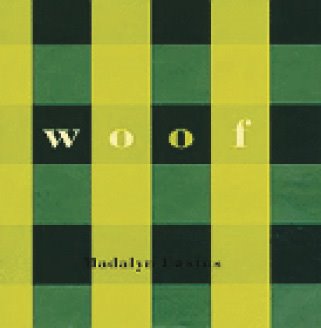
Artist Book: Woof by Madalyn Eastus

In a previous post I wrote about paper cutting and suggested using it creatively in creating artist books. Madalyn Eastus’ book, Woof, is one that does. Don’t let the title fool you though. This book isn't about dogs. Instead, the title comes from the weaving term, woof which refers to the thread which is shuttled back and forth across the warp (the set of lengthwise threads attached to a loom before weaving begins) to create a woven fabric.

Its pages are composed of colored papers that are die-cut and assembled by hand. Each page is a layering of several different pieces of cut paper that are tucked into slits (much like tucking a snapshot into those corners old photo albums used). The patterns evoke a range of traditional textiles from around the world, such as Amish quilts, Navajo blankets, Fair Isle knitted sweaters, and Indian ikats.


One of the things I particularly like about this book is how each pattern is changed by the pages before and after that peek through openings in the patterns.

Monday, August 28, 2006

Featured Artist: Daniel Essig

Thinking about the Pulp Function competition I wrote about yesterday, I realized that books were not mentioned in the blurb about the exhibition but I hope book artists will consider entering. I think a survey of contemporary paper art should include books and there are a lot of book artists who use paper in innovative ways. Daniel Essig is one of them.

Daniel is a full-time studio artist in Asheville, North Carolina. His interest in book arts grew from his introduction to handmade books while he was studying photography at the University of Illinois at Carbondale. One of the first books he made, before he knew how to bind, was an altered book in which he placed his photographs so that viewers had to explore them actively, rather than just wandering past images mounted on a wall.

Around this time, Daniel visited his sister in Iowa City and met her friend, Al Buck, who was making wooden-covered Coptic books, a binding used around the fourth century, in Ethiopia, North Africa. Al followed up and sent Daniel a book he had made with instructions. It took awhile, nearly two years, but Daniel eventually made a book with which he was satisfied.

After completing his degree at Carbondale, Daniel’s mentor Frances Lloyd Swedlund encouraged him to attend the Penland School of Crafts, where he concentrated exclusively on the Ethiopian coptic book structure. Another mentor, Dolph Smith, helped push Daniel beyond the simple Ethiopian book, to developing his bridge books using the same coptic binding, but with exaggerated elements.

It is interesting to note that Daniel still relies on the idea of the altered book. Some of the bridge books (one pictured here) contain well over 1000 pages. Not being able to afford too much new paper, Daniel searches for books with mangled spines and covers but good quality paper to use in his work. He says he does not have a problem with the practice of tearing up old books, because the books he alters are not rare, and they've already lived their lives.

Tuesday, August 22, 2006

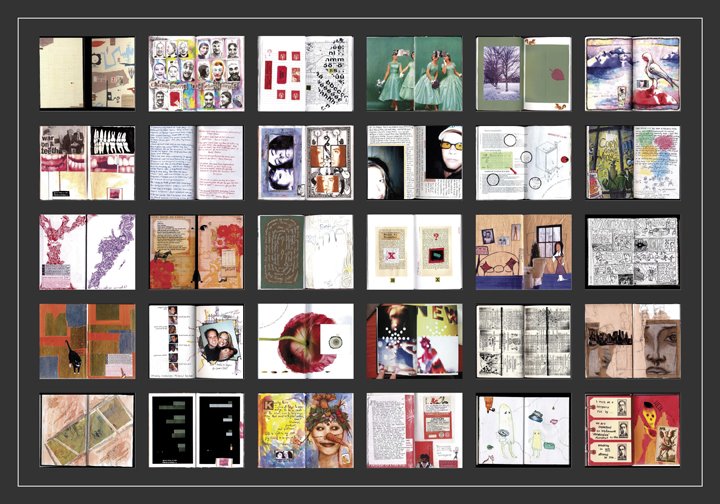
The 1000 Journals Project


Images from journals circulating in Ohio

If you ask a kindergarten class how many of them are artists, they'll all raise their hands. Ask the same question of high school grads, and few will admit to it. What happens to us growing up? We begin to fear criticism, and tend to keep our creativity to ourselves.

The 1000 Journals Project, is attempting to remedy our fear of exposing ourselves creatively by sending out 1000 journals throughout the world. The project began in 2000 when San Francisco graphic designer, Brian Singer, fascinated with the cryptic messages and drawings of bathroom graffiti, wondered what would happen if complete strangers around the world, not just those who happened to share a public bathroom, were able to exchange their private thoughts. As the project has evolved, Brian says, “what happens to the journals is as significant as what happens in them. Are people selfless enough to send them back, or will they find them and keep them?” To date, only one journal has been returned but many pages from the ones still circulating have been uploaded to the site.

Monday, August 21, 2006

1001 Journals

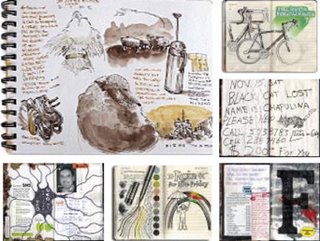
Journals serve a number of purposes. They provide a place to collect ideas, to store clippings of articles, photos … anything that inspires. Journals can be reference books when what is stored are notes about techniques, recipes, swatches, samples or photographs. They can be a repository of events in the life of the journalist or observations, written, drawn or photographed, of the world. If a journal is kept regularly, patterns emerge, patterns that reveal what is attractive/interesting to the journalist and patterns in the journalist him/herself.

Even though there is a trend in making journals works of art, journals do not have to be planned to end up being works of art. Setting such a goal, especially for a beginner, can be intimidating. Better to aim at exploring the process of keeping a journal, and practicing letting go of judgment and inhibitions. For inspiration, take a look at the examples at 1001 Journals, a recently developed website that appears to be growing fast. There you will find a variety of personal and collaborative journals.

Some ideas: writing (pen, pencil, typewriter, computer), calligraphy (brush, pen, ink), drawing (pastels, crayons, pencil, gel pens), painting (watercolor, acrylic, felt pens), photography (black & white, color, polaroid transfers), printing (stamps, patterns, shapes, symbols), collage (pasting, textures, photocopies), resists (oil, wax crayons).