Showing posts with label paper. Show all posts

Thursday, July 02, 2009

Exhibit: A Castle On the Ocean


It took Wataru Itou, a young art major at a Tokyo university, four years to construct this amazing castle, complete with electrical lights and a moving train, made completely of paper!

Saturday, March 08, 2008

Origami Documentary: Between The Folds


A high-resolution version of this trailer can be seen here.

While looking for information about folded book forms I came across this trailer for Green Fuse Films' current documentary project, Between the Folds (working title, Exploring Origami). They have wrapped primary shooting and are in post-production. A special sneak preview will be showing May 31, 2008, at the Parrish Art Museum:
This feature-length documentary illuminates the beauty, complexity and powerful duality of origami in the 21st century, and the unexpected lives it shapes. Viewers will travel far beyond conventional child's craft to discover unforeseen directions in origami that decidedly blur the line between dizzying science and dazzling art. With world-renowned master-artists as guides – many with extensive backgrounds in the advanced sciences – the film sheds light on how origami uniquely fuses form and function, science and sculpture, ancient and new. Produced and directed by Vanessa Gould. Running time approximately 60 minutes.
In the meantime, here is another little film, 6 Artists: On Origami, 13-minutes long, specifically created by Green Fuse Films for the Mingei International Museum in connection with their origami exhibit in 2007.

Sites of some of the featured artists in the film:
Michael LaFosse
Eric Joisel
Paul Jackson
Robert J. Lang
Tom Hull

Thursday, July 19, 2007

Noriko Ambe: Linear Actions & Cutting Project


Noriko Ambe meticulously cuts, and layers hundreds of pieces of Yupo, a synthetic, translucent paper made in Japan, her biggest work having a depth of 1300 sheets of paper. The shapes that emerge call to mind topographical maps, the annual rings of trees, the vastness of space, landscapes, erosion, canyons, aerial views and the passage of time as both subject and process. While many of her works involve unmarked white paper, some involve altering carefully chosen preprinted materials ... because printed matter conveys a message automatically ... such as newspapers, reference books and magazines.

Wednesday, July 18, 2007

Pop-Up Cards to Make


Need a very special card for someone? The Canon 3D Papercraft site has a number of nice pop-ups that you can make. Just download the free instructions, print out the parts and get to work. No need to figure out how to do it yourself . The site also has downloads for gift boxes, animals and origami. You can even print your own Chiyogami (origami paper).

Saturday, May 26, 2007

CBAS: An Afternoon of Papermaking


An "arty" collage of several photographs of most of the people who attended this get together at CBAS member Margaret Rhein's papermaking studio, Terrapin Mill. Several people from the Indiana Book Group made the 100-mile trip to spend the afternoon with us in what was described by one attendee as "paradise," referring to our hostess's beautiful garden and koi pond, a tiny bit of which is visible in the background of this photograph.

Before getting down to the fun of papermaking, we had two important pieces of business, getting to know each other and lunch! We gathered on the deck and those who brought book-related materials, and books they had created, shared them with the group.


The potluck lunch was fabulous!


Margaret, beginning her demonstration, the skylight above shining a spotlight on her presentation. We will be using mini papermaking frames, not the larger one she is holding.


Top left: Couching the very wet pulp onto a felt. A mini frame can be seen in the shadowy foreground.
Top right: Showing how to create an embossed effect.
Bottom left: Bottles of colored pulp.
Bottom right: Drawers of hand-dried plant material, most from Margaret's garden, which she uses in her paper and which she generously shared with us.


Everyone is really concentrating on creating their own unique mini works of art.


The final step, stacking all our felts and pressing out excess water.
Top left: Stacking felts.
Top right: Board placed on top of stacks and waiting to be pushed into the hydraulic press.
Bottom left: Pumping the press. Note the water flowing out.
Bottom right: Removing damp paper and placing on blue paper towels for transportation home and drying.

VoilĂ , paper!

Saturday, April 28, 2007

CBAS Study Group: Six-Needle Coptic Binding


I have been traveling the last two months and, regrettably, have missed the last two study groups, the second session of Interlocking and Woven Book Structures, covering Slit/Slot & Other Paper Hinging Techniques, (see Piano Hinging for part one), and most recently, Potato Print Papers.*

No photograph can convey the simple beauty of the potato print papers that were produced during this last meeting. Even so, I thought I would include one here. As you can see in the photograph above, many of these papers were used in today's project.

Here's a photo of our eager-to-learn group. All that was required of us was that, prior to our meeting, we pick up our precut book boards, covers for the book we were going to make, and cover them, preferably with the decorative papers made the month before.

Our first task was marking and making holes in the book signatures. For this, we used a hole punching cradle, a device to position the signature for accurate hole making.

Here is a closeup of both sides of the cradle, top and bottom. This one is made with medium weight binder's board.

Cran is instructing the group on how to accurately mark their covers for punching so the resulting holes will line up properly with the holes in their signatures.

Jeanne is sewing her first signature to her back cover. Coptic stitch can be done with one needle but we used six needles, worked in pairs. Once we got started, it was pretty easy going. If you are interested in this stitch, check out Keith Smith's Non-Adhesive Binding, Volume III: Exposed Spine Sewings. We worked from one of the diagrams in his book.

I didn't have any stamped paper so I used a paste paper I made in a workshop last year. The term refers to a method of decorating the surface of paper with acrylic or tempera paint mixed in a paste medium. I'll be writing more about this in a future post.

A closeup of the stitched binding. What is nice about the coptic stitch technique is that, once you catch on to the stitching, it is fast, it uses no adhesive (except for what is needed to attach decorative paper to the cover boards), and the book opens flat (nice for sketching and/or journaling).

*Red potatoes were said to be the best.

Tuesday, February 20, 2007

The Toymaker


The Toymaker is Marilyn Scott-Waters, a graphic designer, author and illustrator who has a web site of over 200 downloadable paper toys, holiday cards, valentines, sun boxes, baskets and bags, origami and ephemera... all for you to make. Just print them out, cut, glue and enjoy ... or buy the book. Included among the toys are some simple book and moveable structures:

A Fairy Book (concertina book)
Two Rabbit Friends (popup card)
Cupid on Valentine's Day (sliding window card)
A Little Book About The Circus (one-sheet star book)
Dream Theater (tunnel book)

Saturday, January 20, 2007

Origamic Architecture: Intricate Pop-ups


Origamic architecture is an amazing paper art. It involves the three-dimensional reproduction of architecture, geometric patterns, and everyday objects, on various scales, using cut-out and folded paper, usually thin cardboard. Visually, these creations are comparable to intricate pop-ups.

Like origami, origamic architecture originates from Japan. Tokyo Institute of Technology professor Masahiro Chatani is credited as the art form's creator, a practitioner of it since the 1980s. While his website showcases some incredible examples of his work, the website, Willem’s Origamic Architecture. from which I obtained the images in this post, pairs a photograph of the actual architectural model with the origamic rendering. The models are pretty impressive. To get a feel for what is involved, download one of the models that the site offers and make one yourself.

Himeji Castle, Himeji, Japan, 1333, rebuilt 1601

Saturday, December 16, 2006

Paper: Deckle Edges & Simulations


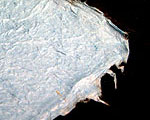
The term deckle edge refers to the distinctive, feathery edge of handmade paper. It occurs when the handmade paper is made. The name comes from the equipment used to make the paper, a mould and deckle. The mould is a wood frame covered with a special papermaking screen. The deckle is an open frame that is placed on top of the mould. The papermaker places the two pieces together and drags them through a vat of fibrous material floating in water, called the pulp, catching the fibers evenly on the screen. The deckle is removed and the sheet of paper is transferred from the mould to an absorbent surface called a felt for pressing the water out of the paper sheet.

Handmade paper normally has four deckle edges and the edges are often quite dramatic while machine-made paper has two and are more subtle. Although early printers looked upon the deckle edge as a defect, and almost invariably trimmed most of it off before binding, in the latter part of the 19th century, it became the fashion to admire the deckle edge for its own sake, and to leave books printed on handmade paper untrimmed. Left in place, the deckle edge becomes a decorative, textured edging.

Simulating a Deckle Edge. A true deckle edge can only be achieved during the paper making process. However, there are various ways to simulate the effect, some more effective than others.
Tearing. The easiest way is to paint a line of clean water with a watercolor brush either freehand or held against a ruler, wait a while, then pull gently. Add more water or pull less gently depending on the strength and the grain of the paper and the effect desired. If you score the line first using a bone folder, then paint with water, the result is a finer edge.

Rulers. Deckle patterned rulers are available against which the paper is torn. A wet tear will achieve a more feathery effect than a dry tear.

Scissors. Although the effect is decorative, deckle scissors, those with irregularly shaped cutting edges, create the least natural looking deckle edge.
Photos of deckle edges (top): left: handmade paper; right: machine-made paper.

Friday, December 15, 2006

Book Formats & Paper Sizes


The traditional terms for describing book formats are derived from early printing methodology and the size of early handmade sheets of paper.

Paper Sizes: the most common names for the original size of paper from which the formats described below were created are:
· Imperial (30 in. by 22 in.)
· Royal (25 in. by 20 in.)
· Demy (22 ½ in. by 17 ½ in.)
· Crown, cr (20 in. by 15 in.)
· Foolscap, fcp (17 in. by 13 ½ in.)
· Pott (15 in. by 12 ½ in.)
A sheet, when folded, has twice as many pages as leaves, for the obvious reason that it is printed on both sides, the number of leaves depending on the size of the original sheet and the way in which it is folded.

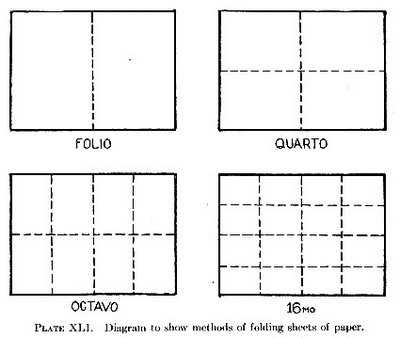
When two leaves (four pages when printed on both sides) were printed on a sheet so that it could be folded once, collated with other folded sheets and bound, the format of the volume was a "folio". When four leaves (eight pages) were printed on the same size sheet, which would later be folded twice, the format of the resultant volume was a "quarto" (four leaves). The term "octavo" relates to the sheet having eight leaves printed on it. The octavo is the most general size of a book, and the printed text is so arranged that, when the sheet is folded, the sixteen pages follow consecutively (see illustration). This folded printed sheet of leaves prior to binding is called a gathering. After binding it is referred to as a signature.

Today some booksellers are providing the height of a book in inches or centimeters rather than using these early terms which do not relate directly to the sheet size or process used for printing today. The following is a guide to convert book formats to approximate book sizes:
· Folio: more than 13 inches tall
· Quarto (4to): approx. 10 to 13 inches tall, average 12 inches
· Octavo (8vo): approx. 8 to 10 inches tall, average 9 inches
· Duodecimo (12mo): approx. 7 to 8 inches tall, average 7.5 inches
· Sextodecimo (16mo): approx. 6 to 7 inches tall, average 6.5 inches
There are smaller and larger books, i.e. many miniatures are 64mo. Most hard bound books today are either octavo or duodecimo in size.

For definitions of other commonly encountered book terms see Glossary of Terms.

Tuesday, October 10, 2006

Peter Callesen: Paper Cut Sculpture


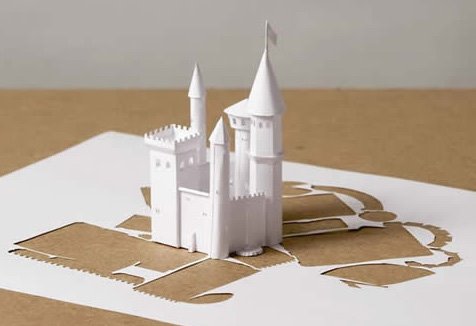
Recently, a friend emailed me about this artist and he is so phenomenal that I want to share him. Peter Callesen is a sculptor who works in paper, transforming a flat sheet (mostly single sheets of 80g. A4 paper, the kind sitting next to your computer printer) into a 3D form, leaving behind the negative space from which the form is created. Some of the the paper cuts relate to fairy tales, while others, Callesen states, “are small dramas in which small figures are lost within and threaten by the huge powerful nature … the thin white paper gives the paper sculptures a fragility which underlines the tragic and romantic theme of the works.

While his work is not specifically book-related, what strikes me when I look at it, is the connection I feel it has to popup books, origami, and silhouette paper cutting, many traditions rolled into one, any of which could be used by creative book artists in their work.

Big Paper Castle, 2004, 7,20 x 7,15 x 3,75 m
Cut and folded from one sheet of 350 gsm paper

Peter Callesen (b. 1968) lives and works in Copenhagen.

Monday, August 28, 2006

Featured Artist: Daniel Essig

Thinking about the Pulp Function competition I wrote about yesterday, I realized that books were not mentioned in the blurb about the exhibition but I hope book artists will consider entering. I think a survey of contemporary paper art should include books and there are a lot of book artists who use paper in innovative ways. Daniel Essig is one of them.

Daniel is a full-time studio artist in Asheville, North Carolina. His interest in book arts grew from his introduction to handmade books while he was studying photography at the University of Illinois at Carbondale. One of the first books he made, before he knew how to bind, was an altered book in which he placed his photographs so that viewers had to explore them actively, rather than just wandering past images mounted on a wall.

Around this time, Daniel visited his sister in Iowa City and met her friend, Al Buck, who was making wooden-covered Coptic books, a binding used around the fourth century, in Ethiopia, North Africa. Al followed up and sent Daniel a book he had made with instructions. It took awhile, nearly two years, but Daniel eventually made a book with which he was satisfied.

After completing his degree at Carbondale, Daniel’s mentor Frances Lloyd Swedlund encouraged him to attend the Penland School of Crafts, where he concentrated exclusively on the Ethiopian coptic book structure. Another mentor, Dolph Smith, helped push Daniel beyond the simple Ethiopian book, to developing his bridge books using the same coptic binding, but with exaggerated elements.

It is interesting to note that Daniel still relies on the idea of the altered book. Some of the bridge books (one pictured here) contain well over 1000 pages. Not being able to afford too much new paper, Daniel searches for books with mangled spines and covers but good quality paper to use in his work. He says he does not have a problem with the practice of tearing up old books, because the books he alters are not rare, and they've already lived their lives.

Sunday, August 27, 2006

Competition: Pulp Function Call for Entries

Exhibition Dates: May 19, 2007 - January 6, 2008
Travel: through 2010

Submission Deadline
: October 1, 2006

About the Exhibition: Paper, that humble material that we use daily and take for granted, emerged in the 1970's as a new material for the substance of art, not just the surface on which to draw or paint. Since then, not only has handmade paper pulp been cast into sculptural reliefs, it has been made into sensuous bowls. Paper cording and rolled newspapers have emerged as popular materials for making baskets and weaving wall hangings. The structural possibilities of recycled paper and cardboard have been explored in furniture and environmental sculptures. Origami paper folding from Japan, and even the timeworn traditions of Jewish, Chinese and Mexican papercuts have found new expression, along with politically charged silhouette murals cut from paper. This survey of contemporary paper art celebrates the updated traditions of paper in art, and a variety of new applications.

Art made from paper pulp, recycled paper, cardboard, papier mache and cut, folded or otherwise manipulated paper will be considered.

Fuller Museum of Art for more information. Click on Exhibitions, then on Pulp Function Call for Entries.

cartoon via The Book Arts Web

Saturday, August 05, 2006

Graph Paper on Demand

Do you need a special type of graph paper to help you layout the design of your new book or box project, or do you need guide paper to practice your calligraphy or Japanese or Chinese brushwork? Perhaps your child needs something special for a class project. Instead of spending your valuable time shopping for it, download what you need from incompetech.com. It's free.

With thirty-two graphs from which to chose, you are sure to find one that is useful and when you do, you can tweak it by adjusting the size, color and line weight of the grid as well as the size of the paper. Once you've got everything the way you want it, print your paper from your web browser or download it as a PDF to your computer to print later.