Showing posts with label book structures. Show all posts

Sunday, September 16, 2007

Perfect Binding


No, perfect binding does not refer to a flawlessly bound book but rather to a method of securing loose leaves into a solid text block by means of an adhesive rather than by sewing, stitching, etc. It is an easy binding to do. Photojojo has a nice how-to video of Judy Lee, owner of Five and a Half, a bookmaking and design studio specializing in journals made from sustainable materials, showing you how to make your own perfect-bound journal using two 4×6 photos for the cover, some paper, glue, and a few other tools.

Sunday, June 24, 2007

Flickr: Coptic Binding


I recently discovered these beautiful examples of coptic stitch and caterpillar binding, by tussenpozen, on the Flickr website. I was surprised to read in her profile that she is ... a young, creative, legally deafblind, zenbuddhistic woman. See her work here.

Thursday, May 10, 2007

Exhibit: Hand Bookbindings, Plain and Simple to Grand and Glorious


The craft and art of binding books by hand was vividly chronicled in an exhibition at Princeton University’s Firestone Library. Entitled Hand Bookbindings: Plain and Simple to Grand and Glorious, the exhibition ran from November 10, 2002 through April 20, 2003 in the Library’s main gallery. While conventional wisdom holds that books cannot be judged by their covers, visitors had a chance to do just that from the most humble of volumes to the most luxurious; from the monastic manuscripts of the twelfth century to the special editions of the twentieth.

Now that the exhibition has run its course, it has been turned into an online display of over two hundred beautifully photographed bindings, divided thematically into twenty-six categories. All the photographs can be enlarged and for even closer inspection, there is a magnifier (the square in the lower right hand corner of each book). Simply click and move it over the area you want to view.

The twenty-six categories:
Introduction - The Early Codex and Coptic Sewing - Early European Sewing and Board Attachment - Later Sewing And Boards Labor-Saving Methods And Materials - Endleaves - Endbands - Edge Decoration - Clasps, Furniture, and Other Closures - Blind Tooling - Panels And Rolls - Gold Tooling - Binding Waste - Aldines - Italian Bindings - German Bindings - French Bindings - British Bindings - Temporary Bindings - Onlays - Bindings For Collectors - Binders' Marks - Modern Conservation Binding - Large And Small, Fixed And Portable - Embroidered Bindings - Bindings From Early Americ - Twentieth Century English And American Bindings

Tuesday, May 08, 2007

Exhibit: Bookworks 8 (LitChick Blog)


The Cincinnati Book Arts Society (CBAS) is holding its 8th annual exhibit of traditional and contemporary handmade books in the Atrium of the Main Branch of the Cincinnati Public Library from May 2 to June 25. Check out this blog for more photos: LitChick: Art of the book celebrated in new exhibit.

Pictured Artist: Margaret Rhein

Saturday, April 28, 2007

CBAS Study Group: Six-Needle Coptic Binding


I have been traveling the last two months and, regrettably, have missed the last two study groups, the second session of Interlocking and Woven Book Structures, covering Slit/Slot & Other Paper Hinging Techniques, (see Piano Hinging for part one), and most recently, Potato Print Papers.*

No photograph can convey the simple beauty of the potato print papers that were produced during this last meeting. Even so, I thought I would include one here. As you can see in the photograph above, many of these papers were used in today's project.

Here's a photo of our eager-to-learn group. All that was required of us was that, prior to our meeting, we pick up our precut book boards, covers for the book we were going to make, and cover them, preferably with the decorative papers made the month before.

Our first task was marking and making holes in the book signatures. For this, we used a hole punching cradle, a device to position the signature for accurate hole making.

Here is a closeup of both sides of the cradle, top and bottom. This one is made with medium weight binder's board.

Cran is instructing the group on how to accurately mark their covers for punching so the resulting holes will line up properly with the holes in their signatures.

Jeanne is sewing her first signature to her back cover. Coptic stitch can be done with one needle but we used six needles, worked in pairs. Once we got started, it was pretty easy going. If you are interested in this stitch, check out Keith Smith's Non-Adhesive Binding, Volume III: Exposed Spine Sewings. We worked from one of the diagrams in his book.

I didn't have any stamped paper so I used a paste paper I made in a workshop last year. The term refers to a method of decorating the surface of paper with acrylic or tempera paint mixed in a paste medium. I'll be writing more about this in a future post.

A closeup of the stitched binding. What is nice about the coptic stitch technique is that, once you catch on to the stitching, it is fast, it uses no adhesive (except for what is needed to attach decorative paper to the cover boards), and the book opens flat (nice for sketching and/or journaling).

*Red potatoes were said to be the best.

Friday, March 09, 2007

Inventing Kindergarten: Early Concertina Books


Kindergarten was created by Friedrich Froebel in the 1830s and grew to become what is now one of the most familiar shared milestones throughout the world. Froebel's kindergarten involved play with so-called "gifts," a series of educational toys, including building blocks, parquetry tiles, origami papers, modeling clay, sewing kits and other design projects, intended to foster curiosity and teach young children about art, design, mathematics and the natural world.

For more teaching aids and early concertina books, visit The Institute for Figuring’s online exhibit, Inventing Kindergarten.

photo: Astonishingly intricate paper weaving workbook by Ms. F. Wegerich, Germany, c. 1880. Very fine strips of paper woven into complex patterns- 19th century predecessors to the digital revolution.

Tuesday, February 20, 2007

The Toymaker


The Toymaker is Marilyn Scott-Waters, a graphic designer, author and illustrator who has a web site of over 200 downloadable paper toys, holiday cards, valentines, sun boxes, baskets and bags, origami and ephemera... all for you to make. Just print them out, cut, glue and enjoy ... or buy the book. Included among the toys are some simple book and moveable structures:

A Fairy Book (concertina book)
Two Rabbit Friends (popup card)
Cupid on Valentine's Day (sliding window card)
A Little Book About The Circus (one-sheet star book)
Dream Theater (tunnel book)

Tuesday, February 13, 2007

Non-Linear Books

For most of us the word "book" presents a visual image of multiple planes, covered and bound together on one side and viewed by turning one page at a time and reading the text from top to bottom and left to right. This is not how it has always been, nor, necessarily how it will be in the future.

The nonlinear visual book has been a part of communication history since the beginning of human life. In terms of the visual transmission of ideas, there are many examples. Before codified systems of writing, objects were decorated or modified in such a way as to communicate a message.
Thus begins the introduction to a fascinating and inspiring journey through non-linear book structures and a discussion of how the presentation of text affects the way we interpret it. The author also shares some thoughts about the future of text and the book in the new electronic age.

Sunday, January 28, 2007

CBAS Study Group: Piano Hinge Books


The Cincinnati Book Arts Society to which I belong has a study group. We meet at a local library, nine times a year, on the third Saturday of the month.

Being a member of the study group means being willing to participate by being in charge of a program. It’s not as scary as you might think. We are a friendly, informal group and you do not have to have a background in the topic you want to share, just agree to learn about it and pass along what you have learned to the study group members. It is also fine to have a joint presentation with another study group member and while most of the meetings are about book structures, this year we are also planning a field trip to a member’s studio.

Our last program was the first of a two part demonstration of interlocking and woven books structures, specifically the piano hinge structure. The image at top left, Crown of Thorns by Tennille Shuster, believe it or not, is just such a structure. The one at top right by our program presenter, Cody Calhoun (who, incidentally has a book in the online Flag Book Bind-O-Rama Exhibit), is the more traditional format. Here is a free tutorial. Don’t be confused by the name, skewered book. Skewers are often used in the construction of this type of book, but piano hinge is the traditional name.

Sunday, January 14, 2007

Flag Book Bind-O-Rama Winners


Have you been wondering who the winners of the Flag Book Bind-O-Rama challenge are? Wonder no longer. The twenty-eight winning books are being featured in an online exhibit on the Book Arts Web. And, as promised, the exhibit also appears in the latest edition of the Bonefolder (Volume 3, Number 1), which I highly recommend downloading and reading, even if it takes a long time for those of you with dial-up connections.


It was hard to chose which books to feature here, they are all wonderful in different ways. Content, materials, and structure are important elements in all but what I found is that usually one dominates and because it does the book makes a statement.

Starting at the top and working down, Hedi Kyle, originator of the flag book technique, uses the traditional structure that she developed, but the very untraditional material of mica to capture the play of light and shadow that has captured her interest. “I often envision the flag book as a movable screen to define space,” she says in her statement. Marcia Ciro’s book compares the man-made car environment with the natural environment. As successful as the comparison may be, the placement of the car side mirrors and their repetition reminds me of clasped hands and interlocked fingers with the mirrors representing fingernails. In Esther Kibby’s book, the Native American story, How Porcupine Got His Quills, is used to explore flag shapes that become a sculptural book. Finally, I could not resist, Sheila Cunningham’s book, Shut Your Mouth. It’s funny and visceral. Makes me want to laugh and tremble at the same time. I'm sure if I get close I will feel the air reverberating.


Top to Bottom:
Hedi Kyle, Philadelphia, PA, USA
Marcia Ciro, Watertown, MA, USA
Esther Kibby, Dallas, TX, USA
Sheila Cunningham, Dallas, TX, USA

Thursday, August 10, 2006

Competition: Flag Book Bind-O-Rama


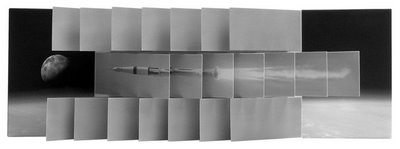
Karen Hanmer, Destination Moon, 2003

Initiated in 2004, the Bind-O-Rama challenge and online exhibition, sponsored by The Book Arts Web, has become an annual event. The 2006 Bind-O-Rama will celebrate the Flag Book structure.

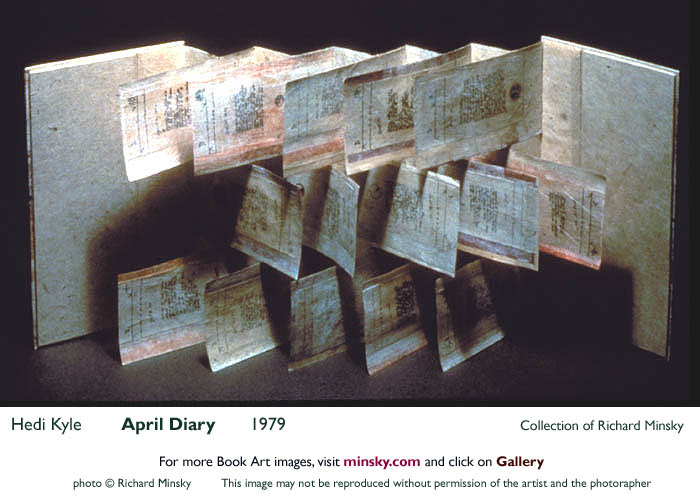
Book artist and conservator Hedi Kyle created the first flag book, April Diary, in 1979. The foundation of the flag book structure is an accordion folded spine to which rows of flags are attached in opposing directions. When read page by page, images and text appear fragmented and disjointed, but when the spine is pulled fully open, the flags assemble into a panoramic spread.

Many flag book creators do not take full advantage of the flag book’s structure to experiment with layering of imagery or text. Too often, they opt for the simple approach of merely attaching bits of images or text to the accordion spine, missing the opportunity to exploit the flap book’s structure, shape and color potential and the book’s spine and cover surfaces for additional imagery or text.

For those not familiar with the flag book structure, there is a tutorial with step-by-step instructions in the Bonefolder, Vol 2, No. 1, Fall, 2005, an e-journal for book binders and book artists. The journal is in PDF format for downloading.

Two Entries (maximum)
No Entry Fee.
Entry Deadline: September 15, 2006