
Saturday, December 16, 2006

Paper: Deckle Edges & Simulations


The term deckle edge refers to the distinctive, feathery edge of handmade paper. It occurs when the handmade paper is made. The name comes from the equipment used to make the paper, a mould and deckle. The mould is a wood frame covered with a special papermaking screen. The deckle is an open frame that is placed on top of the mould. The papermaker places the two pieces together and drags them through a vat of fibrous material floating in water, called the pulp, catching the fibers evenly on the screen. The deckle is removed and the sheet of paper is transferred from the mould to an absorbent surface called a felt for pressing the water out of the paper sheet.

Handmade paper normally has four deckle edges and the edges are often quite dramatic while machine-made paper has two and are more subtle. Although early printers looked upon the deckle edge as a defect, and almost invariably trimmed most of it off before binding, in the latter part of the 19th century, it became the fashion to admire the deckle edge for its own sake, and to leave books printed on handmade paper untrimmed. Left in place, the deckle edge becomes a decorative, textured edging.

Simulating a Deckle Edge. A true deckle edge can only be achieved during the paper making process. However, there are various ways to simulate the effect, some more effective than others.
Tearing. The easiest way is to paint a line of clean water with a watercolor brush either freehand or held against a ruler, wait a while, then pull gently. Add more water or pull less gently depending on the strength and the grain of the paper and the effect desired. If you score the line first using a bone folder, then paint with water, the result is a finer edge.

Rulers. Deckle patterned rulers are available against which the paper is torn. A wet tear will achieve a more feathery effect than a dry tear.

Scissors. Although the effect is decorative, deckle scissors, those with irregularly shaped cutting edges, create the least natural looking deckle edge.
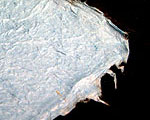
Photos of deckle edges (top): left: handmade paper; right: machine-made paper.

Friday, December 15, 2006

Book Formats & Paper Sizes


The traditional terms for describing book formats are derived from early printing methodology and the size of early handmade sheets of paper.

Paper Sizes: the most common names for the original size of paper from which the formats described below were created are:
· Imperial (30 in. by 22 in.)
· Royal (25 in. by 20 in.)
· Demy (22 ½ in. by 17 ½ in.)
· Crown, cr (20 in. by 15 in.)
· Foolscap, fcp (17 in. by 13 ½ in.)
· Pott (15 in. by 12 ½ in.)
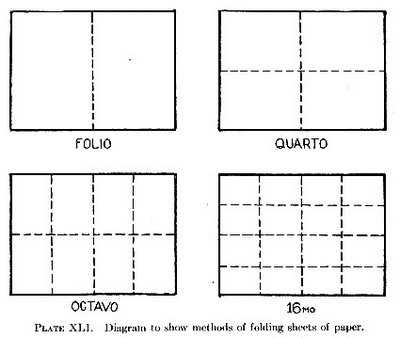
A sheet, when folded, has twice as many pages as leaves, for the obvious reason that it is printed on both sides, the number of leaves depending on the size of the original sheet and the way in which it is folded.

When two leaves (four pages when printed on both sides) were printed on a sheet so that it could be folded once, collated with other folded sheets and bound, the format of the volume was a "folio". When four leaves (eight pages) were printed on the same size sheet, which would later be folded twice, the format of the resultant volume was a "quarto" (four leaves). The term "octavo" relates to the sheet having eight leaves printed on it. The octavo is the most general size of a book, and the printed text is so arranged that, when the sheet is folded, the sixteen pages follow consecutively (see illustration). This folded printed sheet of leaves prior to binding is called a gathering. After binding it is referred to as a signature.

Today some booksellers are providing the height of a book in inches or centimeters rather than using these early terms which do not relate directly to the sheet size or process used for printing today. The following is a guide to convert book formats to approximate book sizes:
· Folio: more than 13 inches tall
· Quarto (4to): approx. 10 to 13 inches tall, average 12 inches
· Octavo (8vo): approx. 8 to 10 inches tall, average 9 inches
· Duodecimo (12mo): approx. 7 to 8 inches tall, average 7.5 inches
· Sextodecimo (16mo): approx. 6 to 7 inches tall, average 6.5 inches
There are smaller and larger books, i.e. many miniatures are 64mo. Most hard bound books today are either octavo or duodecimo in size.

For definitions of other commonly encountered book terms see Glossary of Terms.

Friday, December 01, 2006

Free Online Bookbinding Books

I haven’t had a chance to get deeply into these books, but a cursory look impressed me.

The Art of Bookbinding by Joseph W. Zaehnsdorf
Bookbinding and the Care of Books by Douglas Cockerell
Bookbinding for Beginners by Florence O. Bean
The Binding of Books by Herbert P. Horne
The Story of Books by Gertude Burford Rawlings
A Book for All Readers by Ainsworth Rand Spofford
The Story of Paper Making by J.W. Butler Paper Company
Bookbinding by Paul N. Hasluck

Thursday, October 26, 2006

Hornbooks and Battledores


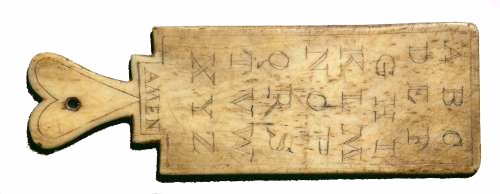
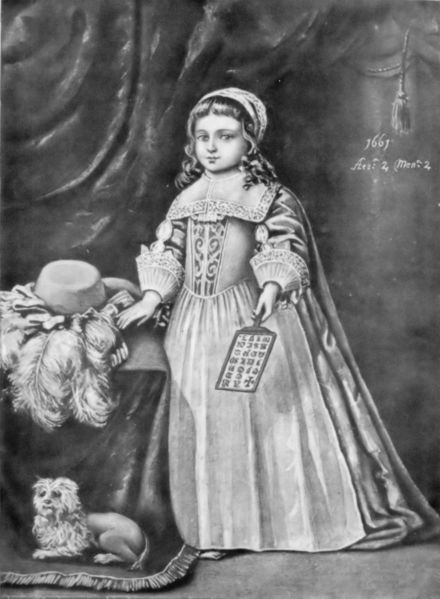
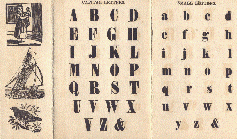
Hornbooks and battledores were two early literacy teaching aids. A hornbook was a primer for children, use from the 15th to the 18th century, consisting of a sheet of paper (or parchment) mounted on a thin wooden paddle, usually with a handle that was perforated so that the hornbook could be hung at the child’s girdle, or belt. The sheet usually had the alphabet, some pairs of letters, and a religious verse, often the Lord's Prayer. Because paper was so expensive, parents and teachers wanted to protect it. So they covered the paper with a very thin piece of cow's horn which was so thin, you could see right through it. Thus, the name, hornbook came to be used to describe this type of “book.”

Not all hornbooks were the same. Many were made out of metal, sometimes even silver. Others had the alphabet carved into paddles made of ivory (photo above). One special kind of hornbook was made out of gingerbread. As children learned each letter of the alphabet, they were rewarded with letters to eat.

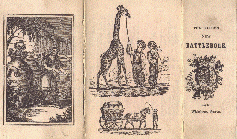
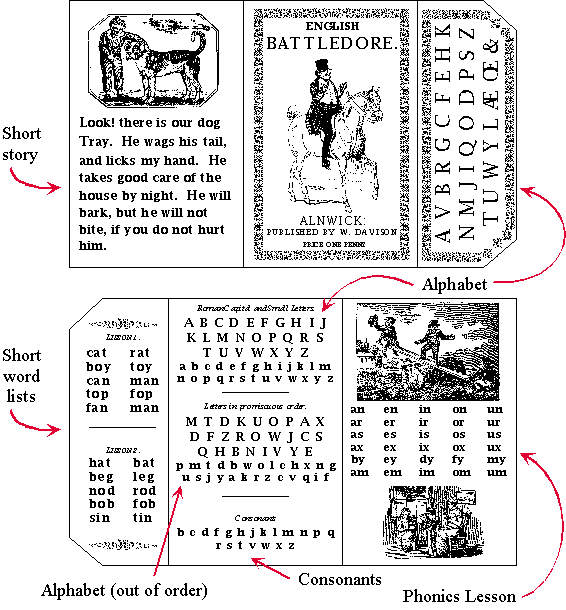
Once the price of paper became cheap, companies started to make battledores. Battledores was an early form of badminton played with a flat wooden paddle and a shuttlecock. The paddle was probably similar in shape/size to hornbooks, thus, the word probably seemed appropriate as the name for the new book form which derived from them. Popular in the 1800's, battledores were made of thin cardboard. Although some battledores were made in the shape of a hornbook, the card was usually cut into the shape of a rectangle and then folded in
thirds.

The content of a battledore was similar to that of a hornbook, including the alphabet in both capital and small letters and pairs of letters as a phonics lesson. But, unlike the hornbook, battledores frequently had a mixed-up alphabet with the letters out of order as a way to help children distinguish individual letters. They also had lists of short words and sometimes included a prayer, but normally they had a short story or fable instead. With a greater surface area, battledores could contain illustrations. These were generally pictures of everyday life that would have been familiar to children of the time.

Tuesday, October 17, 2006

Artist Book: Woof by Madalyn Eastus

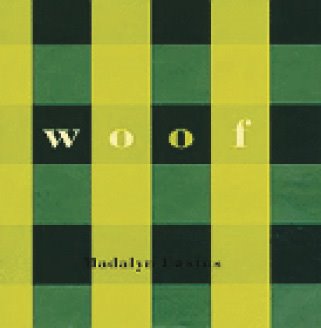
In a previous post I wrote about paper cutting and suggested using it creatively in creating artist books. Madalyn Eastus’ book, Woof, is one that does. Don’t let the title fool you though. This book isn't about dogs. Instead, the title comes from the weaving term, woof which refers to the thread which is shuttled back and forth across the warp (the set of lengthwise threads attached to a loom before weaving begins) to create a woven fabric.

Its pages are composed of colored papers that are die-cut and assembled by hand. Each page is a layering of several different pieces of cut paper that are tucked into slits (much like tucking a snapshot into those corners old photo albums used). The patterns evoke a range of traditional textiles from around the world, such as Amish quilts, Navajo blankets, Fair Isle knitted sweaters, and Indian ikats.


One of the things I particularly like about this book is how each pattern is changed by the pages before and after that peek through openings in the patterns.

Saturday, October 14, 2006

The 1000 Journals Project Film


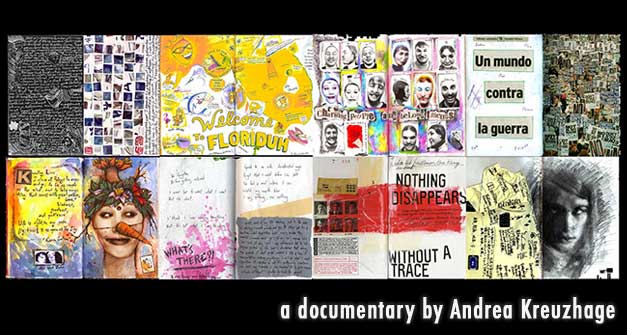
One thousand blank journals are traveling from hand to hand throughout the world. People who find a journal read it, add to it, then pass it on...

Starting in December 2003, the production crew for the 1000 Journals Project documentary film contacted nearly 500 past, present and wait-listed journal contributors from around the world for pre-interviews via email, telephone, and in person, eventually selecting about 120 participants for filmed interviews. The filming took the crew to Europe (France, Germany, Spain, Italy, Croatia, Finland and the United Kingdom), Australia, Singapore, China, Canada and the United States. At the conclusion of postproduction editing, expected by December 2006, the film will be submitted to film festivals around the world for viewing on a big screen in 2007. View the teaser clip.

Tuesday, October 10, 2006

Peter Callesen: Paper Cut Sculpture


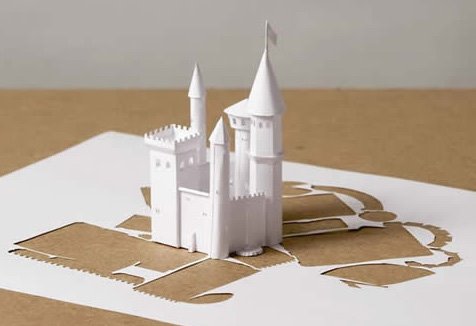
Recently, a friend emailed me about this artist and he is so phenomenal that I want to share him. Peter Callesen is a sculptor who works in paper, transforming a flat sheet (mostly single sheets of 80g. A4 paper, the kind sitting next to your computer printer) into a 3D form, leaving behind the negative space from which the form is created. Some of the the paper cuts relate to fairy tales, while others, Callesen states, “are small dramas in which small figures are lost within and threaten by the huge powerful nature … the thin white paper gives the paper sculptures a fragility which underlines the tragic and romantic theme of the works.

While his work is not specifically book-related, what strikes me when I look at it, is the connection I feel it has to popup books, origami, and silhouette paper cutting, many traditions rolled into one, any of which could be used by creative book artists in their work.

Big Paper Castle, 2004, 7,20 x 7,15 x 3,75 m
Cut and folded from one sheet of 350 gsm paper

Peter Callesen (b. 1968) lives and works in Copenhagen.